
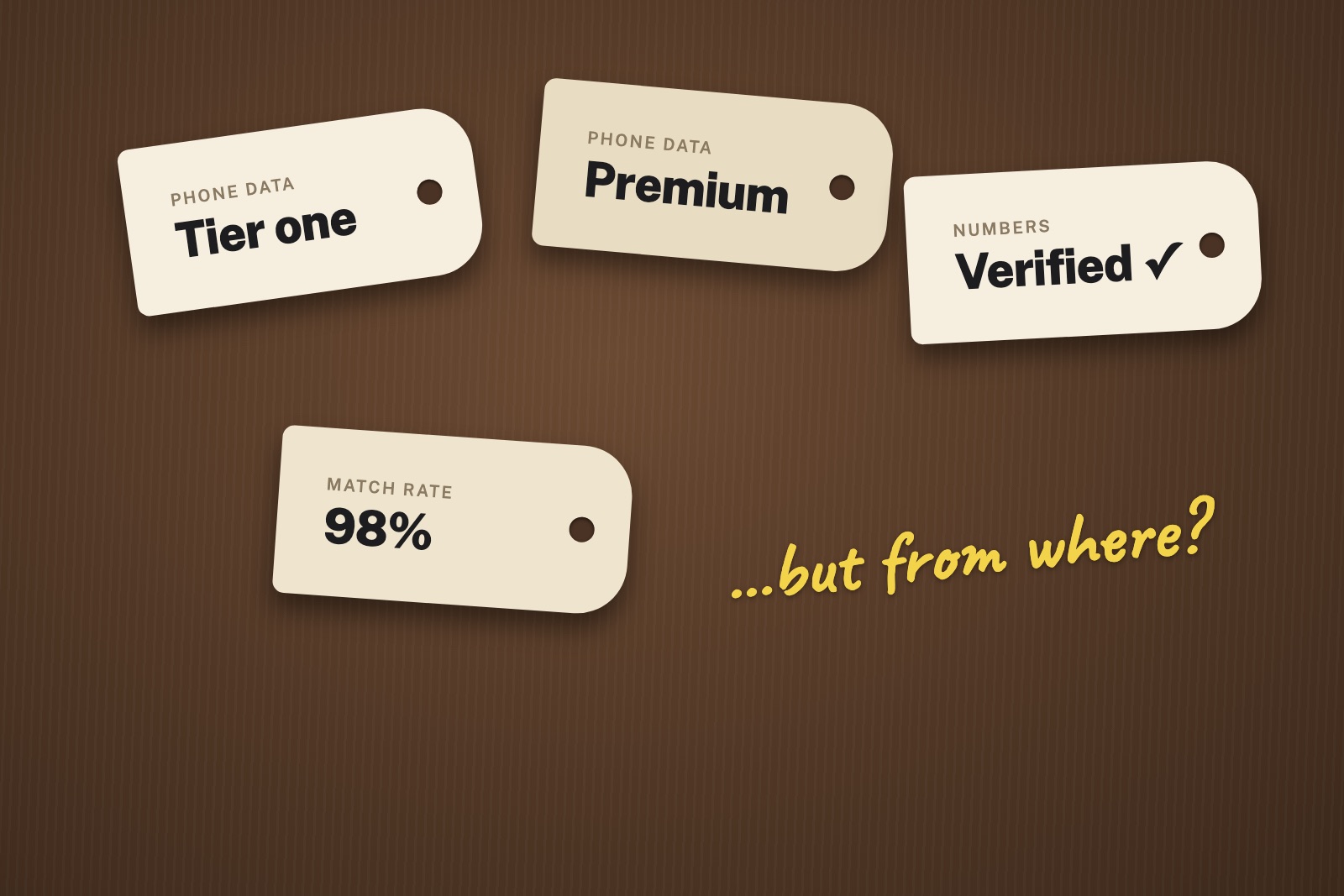
If you've shopped for phone data as an investor, you've seen the labels. Tier one data. Premium data. Verified numbers. A 98% match rate. They sound like grades, the way beef is graded or a bond is rated, so it's natural to assume the higher tier is the better number.
It usually isn't, and not because anyone is lying outright. It's because none of those words has an agreed meaning. There's no grading body for phone data, no standard for what "tier one" has to contain, and nobody checks. Each seller decides what its own labels mean, and the meanings vary a lot.
Four labels, decoded
Here's what each one tends to mean when you look at how sellers actually use it.
1
"Tier one"
Usually a package name
Most of the time, "tier one" is the seller's top package, or the order it runs sources in: check one database first, then fall back to others. Sometimes it means the data was bought from a bigger aggregator rather than scraped. Sometimes it means nothing more than "our best."
What it almost never tells you is where the phone number originally came from, or when it was last true.
2
"Premium"
Usually more, not newer
Premium tends to describe the amount of data, not its age: more numbers per owner, more fields, emails and relatives thrown in. More numbers per owner can feel like better coverage. In practice it often means more numbers to dial before you find out which one, if any, still belongs to the person.
3
"Verified"
Often means the line is on
This is the one that catches the most people. When a seller says a number is verified, it frequently means the line is active: it's assigned to a carrier and it rings. That's a useful check for weeding out disconnected numbers. It says nothing about who answers.
The FCC estimates about 35 million US numbers are disconnected and handed to someone new every year.1 Every one of those reassigned numbers is active, so it rings and passes an "is this line live" check without any trouble. It just rings a stranger.
4
"98% match rate"
Found a number, not the right one
A match rate usually measures how many of your records came back with at least one phone number attached. It doesn't measure how many of those numbers reach the owner. A list can match at 98% and still leave you reaching a fraction of the people on it. Investor CRM REsimpli puts the share of contacts most teams actually reach from a traced list at 30 to 40 percent.2
| The label | What it often means | What it doesn't tell you |
|---|---|---|
| Tier one | The seller's top package or first source | Where the number came from |
| Premium | More numbers and fields per owner | Whether any of them is current |
| Verified | The line is active and rings | Whether it belongs to the owner |
| 98% match rate | Most records got at least one number | How many of those reach the owner |
The question the labels skip: where did the number come from?
Strip the packaging away and nearly all phone data comes from one of two places.
The first is public records and compiled lists: property filings, court documents, old directories and marketing lists, gathered by data brokers and resold, often several times over. This is where most "tier one" and "premium" data lives. It's cheap because it's widely available, and it goes stale because nobody updates a court filing or a 2017 marketing list when someone moves or switches carriers.
The second is credit header data. When someone applies for a credit card, a car loan or a mortgage, they give their current name, address and phone number. The credit bureaus keep that contact information at the top of the person's file, separate from their credit history. People refresh it themselves every time they open an account or move, which is why it tends to be current. It doesn't include scores, balances or payment history. It's contact information, nothing more.
The label tells you what the seller calls the data. The source tells you whether the number still works.
Five questions to ask any data seller
You don't need to know the industry to cut through the labels. You just need to ask questions a label can't answer.
- Where do your phone numbers originally come from? "Multiple premium sources" isn't an answer. Public records, compiled marketing data and credit header are.
- When was this number last updated, and what updated it? A number re-collected from the same old filing isn't fresher just because the file is new.
- Does "verified" mean the line is active, or that it belongs to this person? Those are very different checks.
- Is your match rate "found a number" or "reached the owner"? If they only track the first one, that's your answer.
- Do you check what I'm using the data for? Credit header data can only be sold to businesses with a permitted use, so a seller offering it has to review who's buying. If anyone can sign up and search in thirty seconds, it's very unlikely to be credit header.
Where credit header data is available
Because access is restricted, credit header data mostly went to banks, collection agencies and large investigation firms for years. Smaller operators got the recycled records under nicer names.
Quivor, the sponsor of this story, offers credit header phone data to independent investors, wholesalers and small teams. You search by name, property address, business or phone number and get back the people connected to it, their numbers and their relatives. Plans start at $99 a month with 75 searches included, after a short review of your business and what you'll use the data for.
See if your business qualifies for credit header data
Whatever you use, check the National Do Not Call Registry and your state's rules before you dial.
Done paying for labels?
Tell Quivor about your business and what you'll use the data for. If it's a fit, your account gets turned on and you can run your next owner.
Check if you qualify US businesses only. Accounts are reviewed before access is turned on.- Federal Communications Commission, Second Report and Order establishing the Reassigned Numbers Database, December 2018.
- REsimpli, investor CRM, published estimate of typical contactable rates for traced lists.