
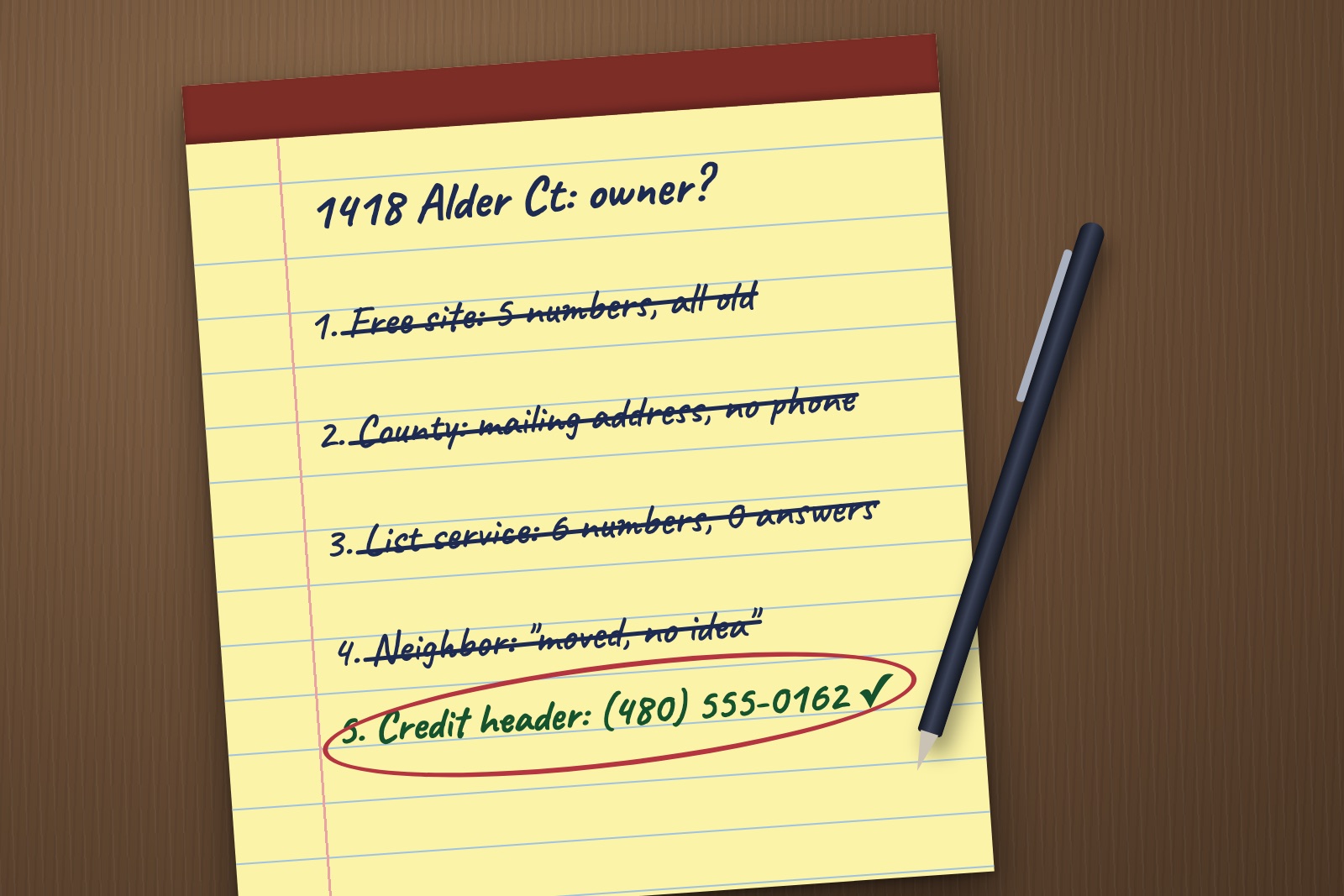
You've got the address. You've got the owner's name off the county site. What you don't have is a number that rings in their pocket. Every investor ends up here sooner or later, and there are really only five ways out.
Some are free, some are fast, and a couple of them quietly eat more of your week than they save. Here's how each one works, where its numbers come from, and when it's worth your time.
Why owners are so hard to reach
Contact details go stale faster than most lists admit. People move, switch carriers and drop landlines, and the old number gets handed to a stranger. The owners you most want to talk to, the ones with a vacant or inherited house, are often the ones who've moved more than once.
US phone numbers disconnected and made available to someone new every year
FCC estimate1of Americans moved in a single year (2022)
US Census Bureau2of contacts most investor teams can actually reach from a list run through a phone data service
REsimpli estimate31
Free people-search sites
Fine for a quick look
Type in a name and you get a page of phone numbers, past addresses and possible relatives. It's free or close to it, and it takes about a minute.
The catch is where those numbers come from: old directories, property filings, court records and marketing lists, collected and republished. Nobody updates them when someone moves or changes carriers, so you often get five numbers and no way to tell which one, if any, still works.
Good for: a first look at a single owner. Not good for: anyone who's moved in the last few years.
2
County records and the tax bill
Great for addresses, no phone
The assessor and recorder sites tell you who owns the property, when they bought it and where the tax bill goes. That mailing address is gold, especially for absentee owners and inherited homes where the bill goes to a relative in another state.
What county records won't give you is a phone number. You can mail the owner, and that works, but slowly. You're waiting on them to call you, and so is everyone else who mailed them this month.
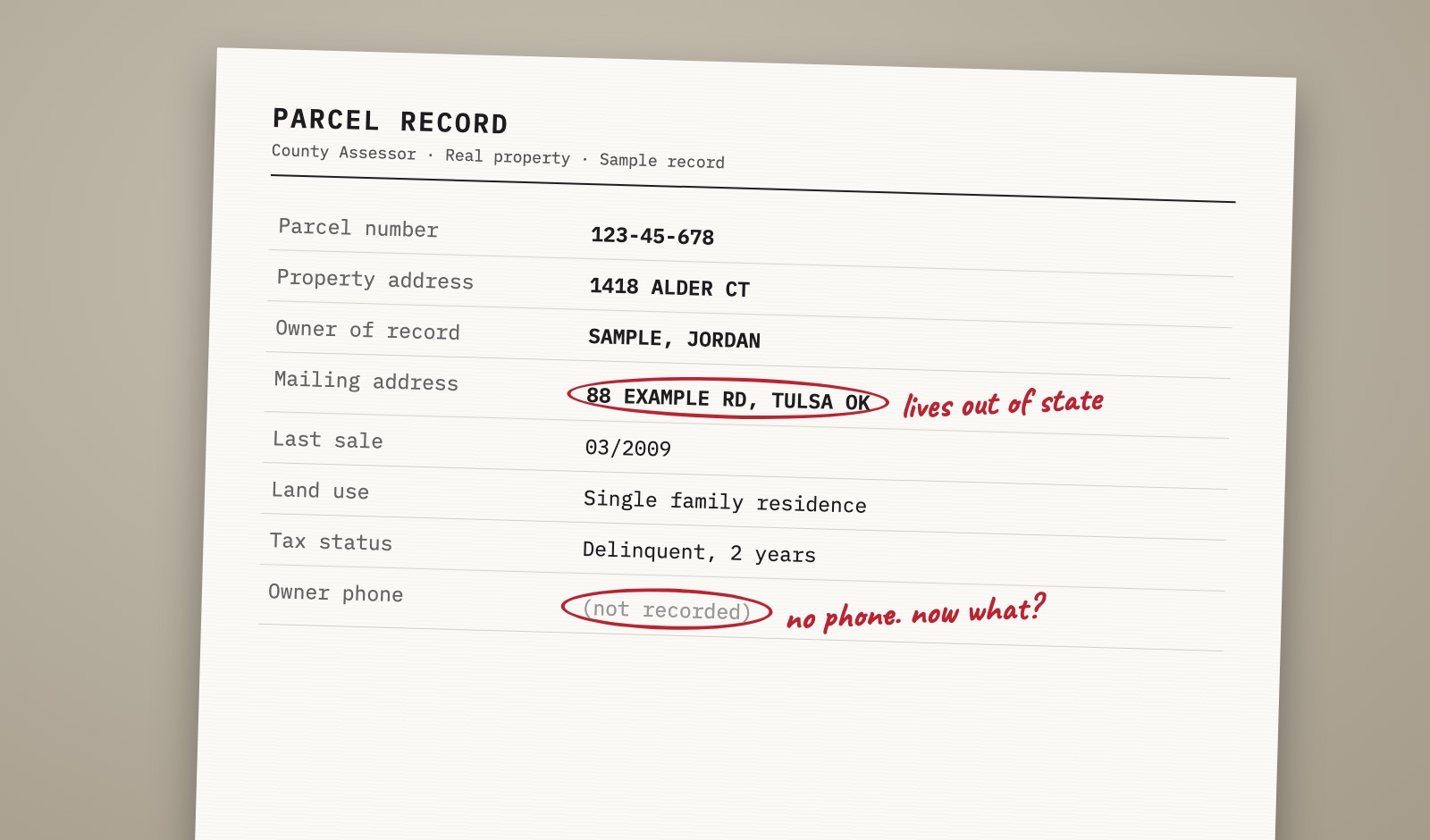
Good for: confirming the owner and finding where they actually live. Not good for: talking to anyone this week.
3
Bulk list services
Cheap per record, costly per call
Upload a spreadsheet of owners, pay a few cents a record and get it back with phone numbers attached. It's how most wholesalers fill a dialer, and the price per record looks great.
Most of these services draw on the same public-records sources as the free sites, repackaged as "tier one" or "premium." You usually get several numbers per owner and work through them one by one. If your team reaches 30 to 40 percent of a list, most of what you paid for turns into dialing time on numbers that go nowhere.
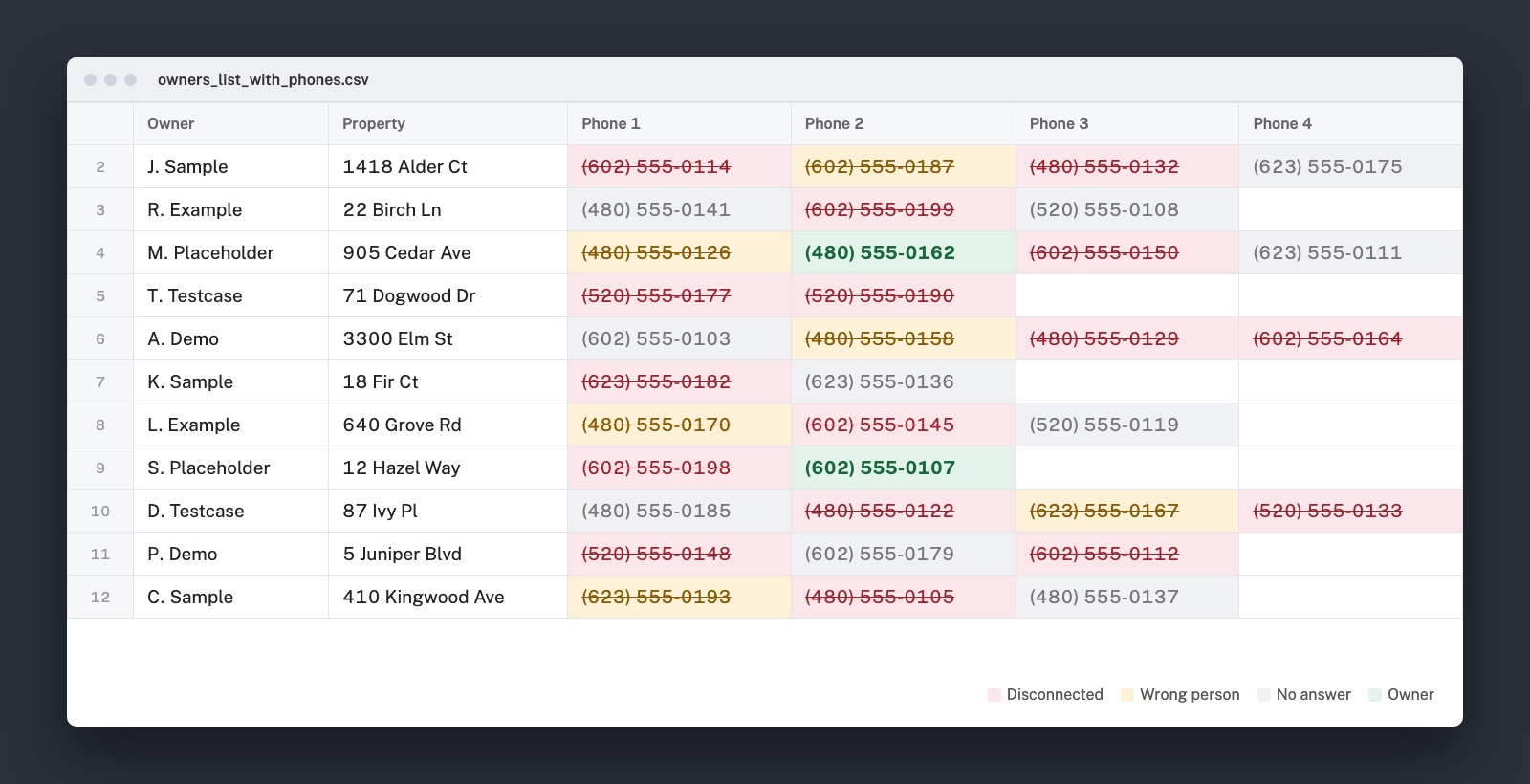
Good for: volume, when you have a dialer and someone to run it. Not good for: the specific owners you most want to reach.
4
The front door and the neighbors
Works, doesn't scale
The oldest method still has its moments. A neighbor who's been on the street for twenty years often knows exactly where the owner went, and sometimes has a number. Searching the owner's name with the city on social media can do the same thing from your couch.
It costs nothing but time, and that's the problem. It's hours per owner, and the door only works on properties you can drive to.

Good for: a handful of high-value properties nearby. Not good for: a list of 500.
5
Credit header data
The one that updates
When someone applies for a credit card, a car loan or a mortgage, they give their current name, address and phone number. The credit bureaus keep that contact information at the top of the person's file, separate from their credit history. That's credit header data.
Because people update it themselves every time they open an account or move, it tends to be current in a way the other sources aren't. It also links people to their relatives and past addresses, which helps when the owner has passed away or the house was inherited. It doesn't include scores, balances or payment history. It's contact information, nothing more.
The trade-off: access is limited to verified businesses with a permitted use, so you can't just sign up and search, and it costs more than a few cents. Quivor, the sponsor of this story, offers it to independent investors and small teams. Plans start at $99 a month with 75 searches included, after a short review of your business.
Good for: the owners worth reaching, and the ones every other method has already failed on. Not good for: running 10,000 rows for pennies.
The five side by side
| Cost | Time | Phone number? | Updates when people move? | |
|---|---|---|---|---|
| Free people-search sites | Free | Minutes | Several, often old | No |
| County records | Free | Minutes | No, mailing address only | When the tax roll does |
| Bulk list services | Cents per record | Hours per list | Several per owner | Rarely |
| Door and neighbors | Free | Hours per owner | Sometimes | Depends who you ask |
| Credit header data | $99 a month, 75 searches | Minutes | From the person's latest credit file | Yes, when they open an account or move |
So which one should you use?
The investors who reach owners consistently don't pick one. They stack them. County records to confirm the owner and the mailing address. A free site or a cheap list for a first pass. And for the properties that matter most, the vacant house, the inherited place, the owner who's never picked up, a source that actually updates.
Whatever you use, check the National Do Not Call Registry and your state's rules before you dial.
Cheap data is priced per number. You pay for it per call.
Five dead numbers at a few cents each aren't cheap if they cost you twenty minutes and the deal goes to whoever reached the owner first.
Got an owner you can't reach?
Tell Quivor about your business and what you'll use the data for. If it's a fit, your account gets turned on and you can run that address.
Check if you qualifySee if your business qualifies
Check whether you can get credit header phone data for your next list.
Check if you qualify US businesses only. Accounts are reviewed before access is turned on.- Federal Communications Commission, Second Report and Order establishing the Reassigned Numbers Database, December 2018.
- US Census Bureau, Current Population Survey, geographic mobility estimates for 2022.
- REsimpli, investor CRM, published estimate of typical contactable rates for traced lists.